

In 2017, historian David J. Goodwin published the definitive account of what happened at 111 First Street in Jersey City, the site of the historic tobacco factory that turned into an artist’s colony.
Though the memory of the historic factory fades with the years, Goodwin’s book Left Bank of the Hudson, published nine years ago, is an important reminder that this building and its artists are why the Powerhouse Arts District is what it is today.
The first artists — 28 of them — moved into 111 First Street in the 1990s, a time when industry had abandoned Jersey City’s shipyard, turning the waterfront neighborhood into a desolate, seedy place. At the time, many hoped artists moving into the city’s underutilized waterfront could replicate what happened in Brooklyn DUMBO, where an arts and music scene revived an abandoned industrial zone and spurred preservation efforts. The newly restored Domino Sugar Factory is one of DUMBO’s great preservation stories.

However, 111 First Street was eventually demolished in 2007, an incredible loss not only for the artists who worked there, but for preservationists who hoped to save the building. It was even landmarked, but that protection was stripped after the owner, New Gold Equities, sued the city government.
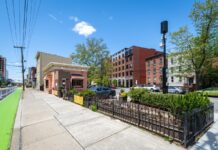
The story of 111 First Street left many questions unanswered today. Although plans were revealed to build a new skyscraper designed by Rem Koolhaas’s firm, with groundbreaking slated for 2008, the lot remains vacant to this day, despite being owned by the same developer, New Gold Equities. As Goodwin’s book is about to turn 10, the lack of progress is a little glaring.

“That’s one of the greatest mysteries of this whole saga,” Goodwin told Jersey Digs. “There was such an impetus to get this building emptied out, get the tenants evicted from the building, and to tear it down. The lot is still vacant. So what was the rationale for getting that building emptied if it wasn’t going to be developed?”
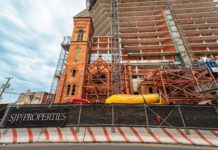
Meanwhile, the Powerhouse Arts District has become one of Jersey City’s most sought-after neighborhoods. Among newly built 40-story skyscrapers are also renovated historic warehouses that show — at least in an alternate timeline — what could have happened at 111 First Street.

“Everything else around there has been developed or is in the process of being developed. It’s not as if the area itself has been abandoned by capital or real estate interests or by people looking for housing,” Goodwin said. “Why is it empty? I have no answer, and I’ve never gotten an answer that I found satisfactory.”
Goodwin’s book posits that what happened at 111 First Street in many ways is a retelling of the gentrification process, where artists move into a dilapidated area seeking cheap studios, and soon bring a cachet to the neighborhood that attracts developers and soon, the artists who rediscovered the neighborhood are priced out of the neighborhood.
Although 111 First Street no longer exists, its influence still ripples into the present day. The Powerhouse Arts District now includes the Nimbus Arts Center, galleries like Arts 14C, and a soon-to-open 550-seat theater for the New Jersey Symphony. The Jersey City Art Open Studio Tour, which launched at 111 First Street, is still alive and well.
“We’re trying to do something similar to what 111 First Street did and learn some of the lessons from their lack of success,” said Robinson Holloway, the founder and CEO of ARTS 14C, who carries on the JCCast. “Artists need power.”
“One thing I do remember from the book is that there were moments when you feel it could have succeeded because there were a lot of people who wanted the arts to flourish and wanted to keep the artists in place,” Robinson. “So many artists were scattered, and Jersey City lost many artists to other places. And it wasn’t even replaced with a building; it’s still a scar that says a great opportunity was squandered.”
Meanwhile, local preservationists determined not to repeat what they saw at 111 First Street and fought to have developers adaptively reuse other important relics of Jersey City’s industrial era, including the Great Atlantic & Pacific Tea Company Annex. That fight is never truly over.
Now preservationists have turned their attention to another landmark in the Powerhouse Arts District — the eponymous powerhouse itself. The Port Authority is finally supposed to vacate the building and turn over the keys, at which point planning can begin about what to do with the site. While no one can reconstruct 111 First Street, many hope the powerhouse will carry on its legacy.