
One of the first lessons a preservationist learns is that no historic building is safe. Not even the ones that have landmark designations. Not even the ones that institutions have sworn to protect.
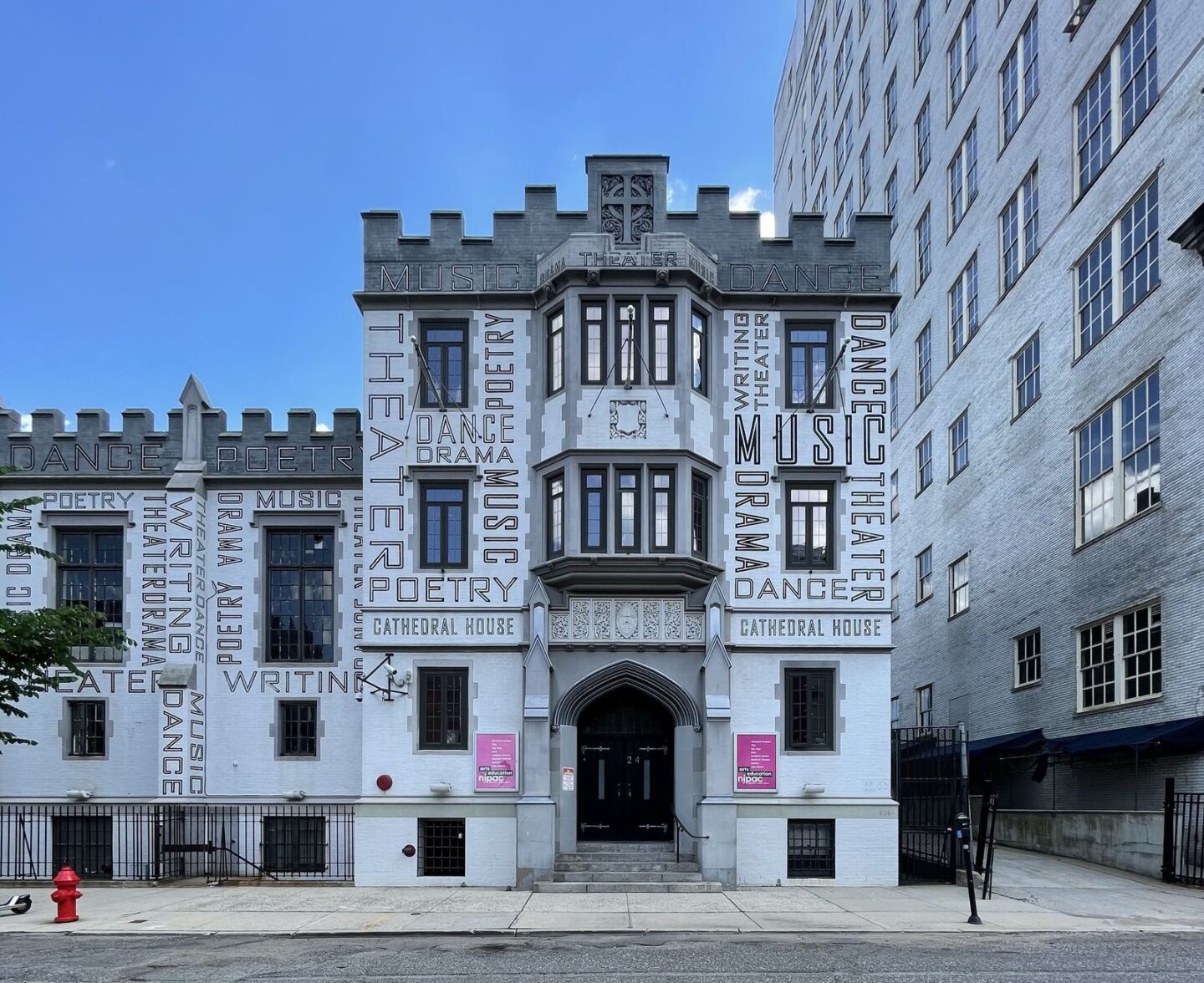
Once again, the Cathedral House, a former rectory on NJPAC’s campus in Newark, is being proposed for demolition at tonight’s Landmarks Commission meeting. The application cites unspecified “environmental conditions discovered within the building” as grounds to save only part of the facade while demolishing the rest of the building.
What makes this news so shocking to preservationists is that they spent 2022 fighting to save the building — and they thought they had succeeded when NJPAC agreed to spare the building.
“We thought these issues were resolved three years ago,” said Tom Ankner, board president of Newark Landmarks, a group responsible for getting the building listed on the National Register. “Why is it suddenly being proposed again? What is it about this moment in time?”
One concern that Ankner’s organization has this time around is that a number of voting members have been added to the Landmarks Commission in the past year who have relationships with NJPAC that could pose conflicts of interest. The commission’s current chair, Anthony Smith, is a former NJPAC executive, and the newly appointed commissioner, Rebecca Jampol, is the director of a nonprofit, Project for Empty Space, which is currently collaborating with NJPAC on a series of murals called Stories in Sound, Movement, and Community. Linda Caldwell Epps is listed as a member of NJPAC’s Theater Square Development Company’s board of managers. Ankner believes the commissioners with conflicts should recuse themselves, which could complicate the effort to get five votes, required for a demolition approval.
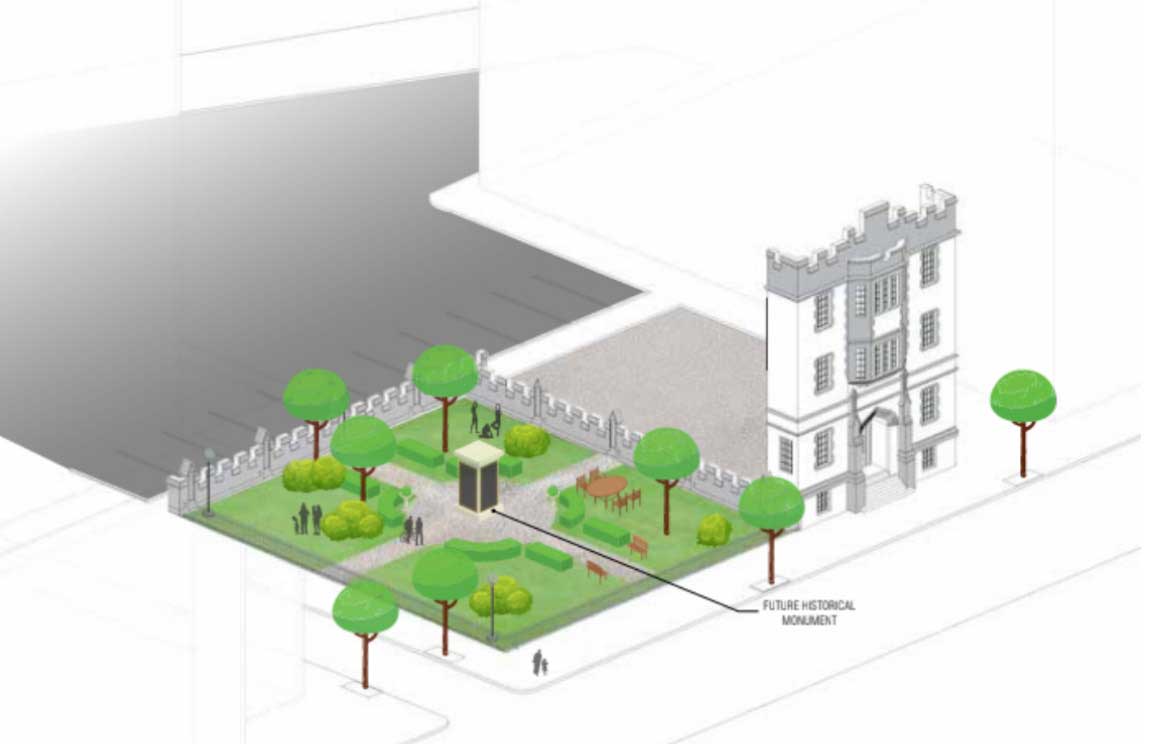
In the building’s place, NJPAC is proposing a history-themed park to honor the National Black Power Convention held there in 1967. It is almost certain that NJPAC will present an expert to testify to the conditions mentioned in the demolition application that warrant the building’s demolition. But the claim has already raised eyebrows because the building doesn’t have a history as an industrial building.
“This building was never used for any kind of industrial purpose,” said Susana Holguin-Veras, a Newark Landmarks board member and a former Landmarks Commission vice chair who presided over the application in 2022. “Remediation efforts have advanced to the point where almost anything short of nuclear waste can be remediated.”
The building at 24 Rector Street, built in 1941, was originally the rectory of the Episcopal Diocese of Newark. But the building has had other meaningful chapters, notably serving as the stage for the National Black Power Conference in 1967. The convention was likely held within the building because of Dr. Nathan Wright, who was the chairman of the conference and also led the diocese’s Department of Urban Work, which was headquartered at the Cathedral House at 24 Rector Street.
The facade on the Cathedral House also served as the canvas for a famous mural by Paula Scher, who spoke to this publication about the importance of preserving the building in the days leading up to NJPAC’s decision in 2022 to save the building — a promise that it is now being rescinded.
Unfortunately, some of the city’s most prominent institutions have been the worst offenders in destroying landmarked buildings in Newark. Prudential decimated a row of buildings along the 600 block of Broad Street within the Four Corners Historic District for a proposed tower that still hasn’t been built. NJIT’s plans to expand its campus drew the ire of James Street residents when it demolished the Warren Street School in 2021, though the university’s leaders have since earned back some goodwill after revealing plans this year to restore the Yellow Cab Building.
But NJPAC has a unique duty to protect the remaining buildings that it owns within the Military Park Historic District, listed on the National Register. In 1993, the arts organization entered into an agreement with the State Historic Preservation Office to protect the Cathedral House and the Chancery Building. This agreement was made after NJPAC built its current performance hall in 1997, which required demolishing five historic buildings, including the Military Park Hotel and disinterring the remains of the Trinity Church Cemetery.
“Most of the city is not landmarked,” Holguin-Veras said. “Why does NJPAC have to develop in a historic district?”