
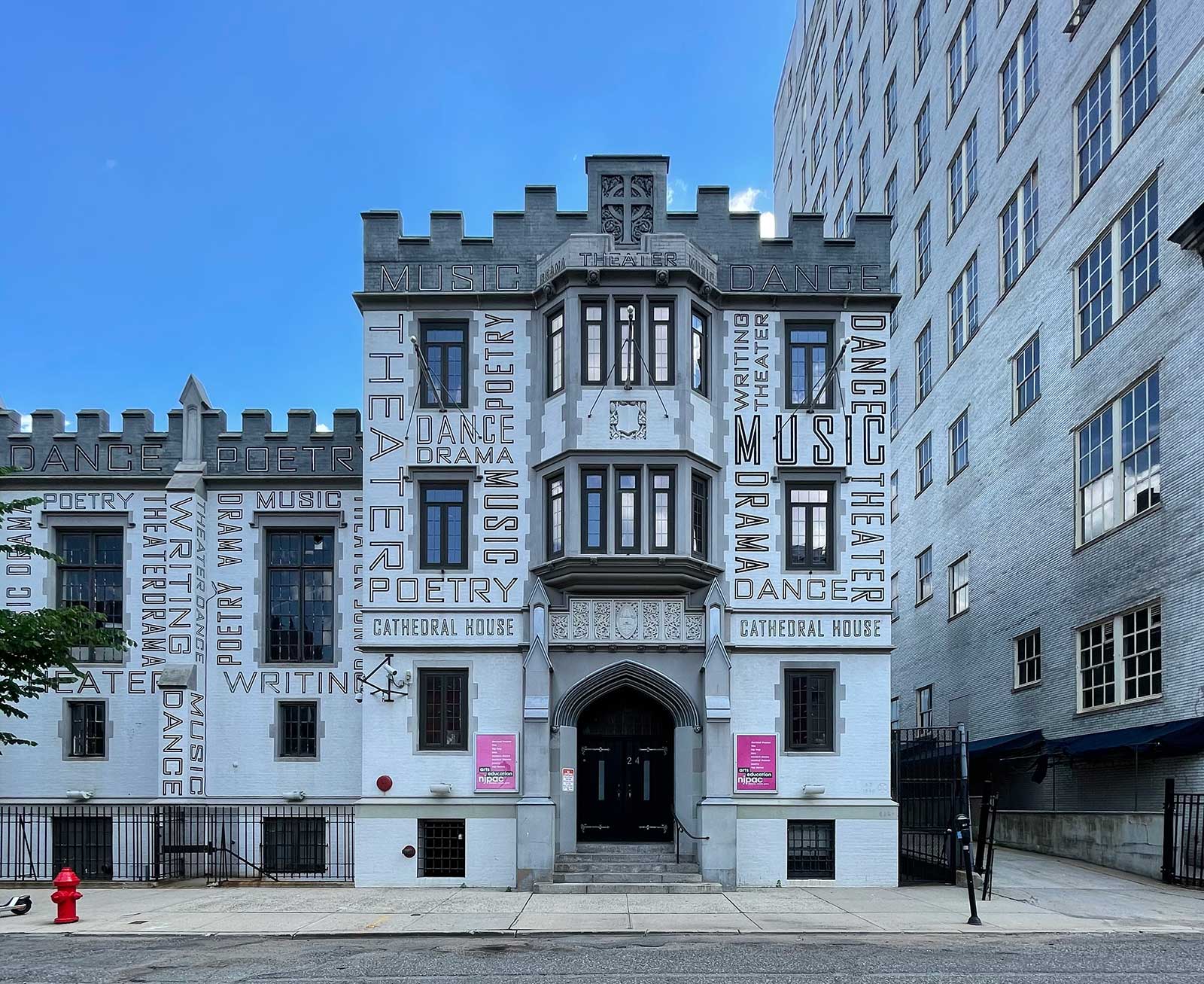
It is one of the most controversial demolition approvals in Newark since NJPAC razed the Military Park Hotel. Newark’s Landmarks Commission voted 5-2 this month to allow NJPAC, once again, to tear down a beloved building in a historic district. This time it’s the Cathedral House — a building that the arts organization swore to protect in 1993.
The decision has left the city’s preservationists mourning both the loss of yet another important historic building and the state of preservation in the nation’s third-oldest city.
The reason NJPAC gave for demolishing the Cathedral House, a 1941 rectory building of the Episcopal Diocese of Newark, was the presence of asbestos. Their argument was that the asbestos would be too expensive to remediate and imperil other redevelopment projects, even plunge the organization into “grave financial circumstances.”
John Schreiber, NJPAC’s president and CEO, said that their ongoing $300 million redevelopment project hinges on receiving a grant from the Newark-based NJEDA, which has stringent deadline requirements.
“Asbestos remediation on this scale would imperil all the project’s financing and the funding received under the Aspire award,” Schreiber said. “A full remediation of 24 Rector would make it impossible to meet these deadlines — if we attempt it, we put the entire ArtSide project into jeopardy.”
Historian Junius Williams, who appeared at the previous meeting in December sitting beside Schreiber in a show of solidarity, revealed another reason why NJPAC may want to demolish it — they don’t need the building anymore now that their arts education programs will be moved to the Cooperman Center, currently under construction.
“There’s no doubt about it, it’s a nice building, and the advocates for keeping the building have not talked about the elephant in the room, and that is the expense, the operating expense, for keeping that building open,” Williams said. “The functions of that building — all of those are going to be shifted to the Cooperman Center.”
Sydne Nance, one of two city commissioners to vote against the demolition, cautioned the commission that NJPAC’s financial situation could not be a factor in their decision, according to language in the ordinance that formed the commission in the 1990s.
“I’m not sure we can evaluate this based on economic hardship,” Nance said.
But her advice, along with emotional pleas to save the building and reminders from the public about the city’s historical indifference toward preservation, didn’t sway enough commissioners who voted 5-2 to approve the demolition.
There is growing concern about the direction the Landmarks Commission is taking after the previous two chairmen were forced to resign for refusing to issue a letter of support for the city’s pedestrian bridge at Penn Station.
In 2024, the city’s business administrator, Eric Pennington, drafted a resolution ordering the removal of longtime chair Richard Partyka. It was never voted on, but Partyka resigned shortly after, followed by the Vice Chair Susana Holguin-Veras.
In the past, preservationists have been concerned that the Landmarks Commission has been undermined by outside interests, namely, real estate developers and city officials. But many believe the Landmarks Commission is now being undermined from within itself — by members who don’t understand their role or don’t care about the cause of preservation, showing more concern for economic development or creating parks and murals on the sites of demolished historic buildings. The comments made by sitting commissioners — calling historic buildings “undemocratic” — certainly did little to change that opinion.
Myles Zhang, the other commissioner to vote no, criticized the frequently repeated argument — coming from Williams and commissioners Linda Caldwell-Epps and Rebecca Jampol — that replacing the Cathedral House with a park would be a better way to commemorate the building’s history than the building itself.
“I would solemnly disagree that a park is a better way to remember that structure than the building itself — a structure is living,” Zhang said. “It is so powerful to touch the same doors and see the same windows that these people experienced 100 years ago.”
The consensus among the members of the public who opposed the demolition during the public comment session was that the commission was far too conflicted to vote objectively on the application.
At the beginning of the meeting, Anthony Smith, the commission chair, disclosed his former employment with NJPAC but, despite calls for his recusal, still voted in favor of the application.
Other commissioners, Jampol, Caldwell, Epps, and Roger Smith, recused themselves because of current ties to the applicant, but all nevertheless spoke in favor of demolition.
“It’s disheartening to hear most of you with the connections that you have to NJPAC, the city, will come on here and blatantly advocate for this applicant,” said Tammy Halloway, a James Street resident.
Zhang, in his closing remarks after the 5-2 vote was cast in favor of demolition, struck a somber tone about the precedent this could set.
“I don’t think I would ever see another Landmarks Commission approving this, but I could see this being approved in Newark because I think Newark has historically had a worse track record of historic preservation than any other city, many other cities, in the American northeast,” Zhang said. “This approval sets the pace for the future of Newark, and I really don’t think that’s a good thing.”