

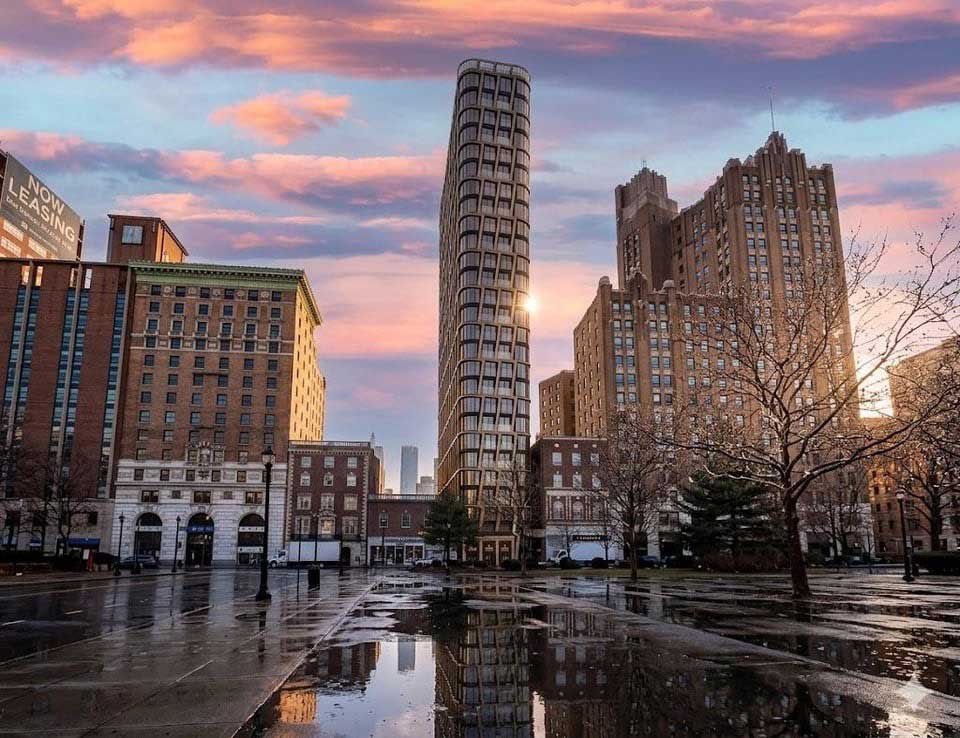
The Robert Treat Hotel and WBGO were among a group of objectors to fend off a plan to build a 27-story building in Newark’s Military Park Historic District.
The opposition hired Calvin Souder, a lawyer who often represents clients advocating for some of the tallest towers approved in the last few years, including the Arc Tower and the Summit Tower. This time, he found himself on the other side, fighting against what would have been the tallest building in the historic district.
One of the objections he raised was that the plan had substantially changed since the Landmarks Commission approved the application in 2024. The proposal required the commission’s approval because it is located in a historic district. In that application, the building offered 55 parking spaces, but in the latest application that came before the Planning Board, which denied it, the developer didn’t provide any parking, despite zoning laws requiring 157 spaces, and sought a variance.
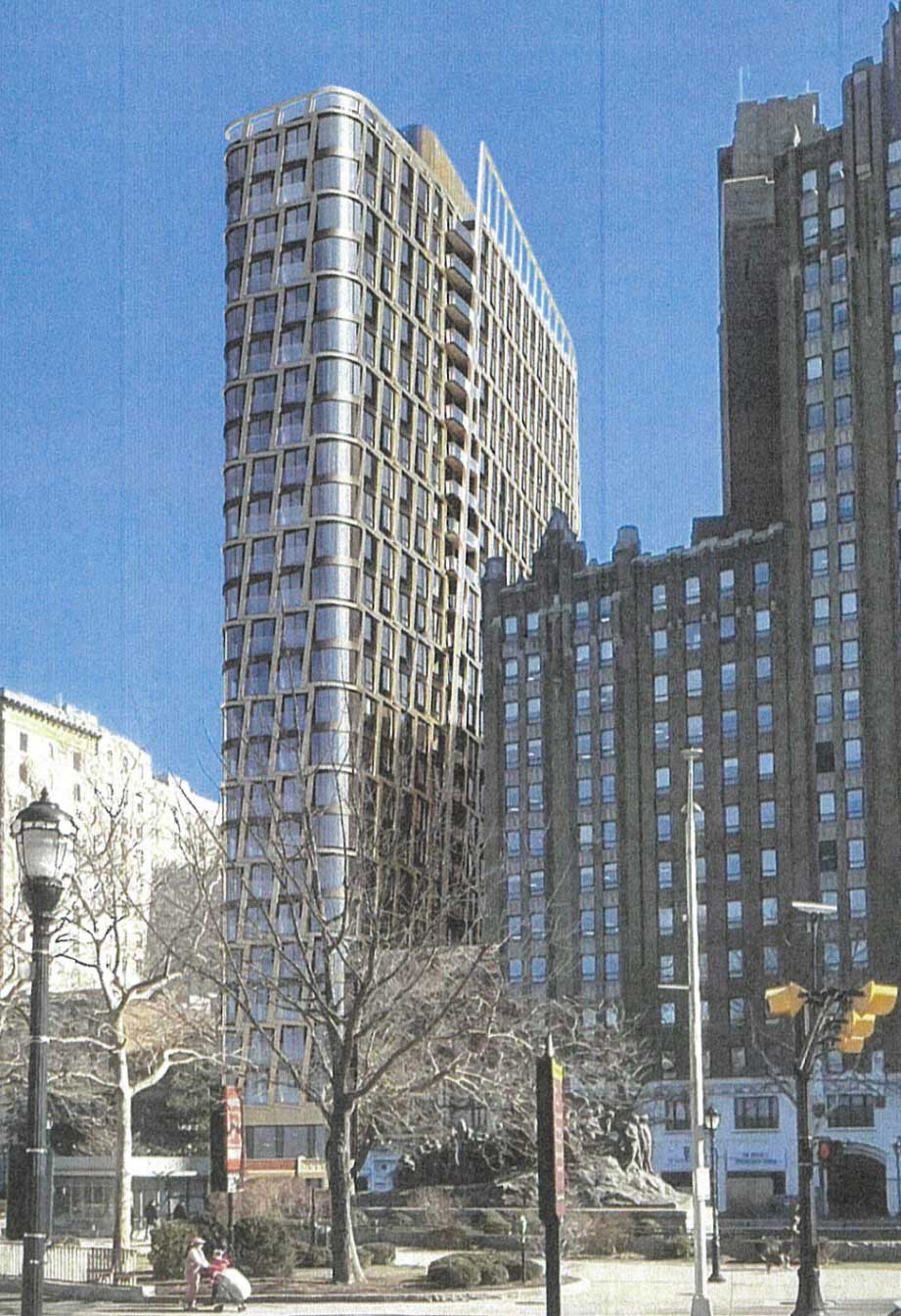
There were other objections raised during the hearing, including the feasibility of using the Kitchell Place alleyway behind the building — an 1800s easement dating back to Newark’s horse and buggy days — as the main entryway into the building. But the parking issue is perhaps the most salient, as it serves as a test case for future development.
Newark is unique in that three of its seven historic districts are located in its downtown commercial area. In the past, this has created challenges for developers, who have often encountered pushback from preservationists over how tall they can build and which buildings can be demolished.
However, that wasn’t the case for 56 Park Place, LLC, when it came before the Landmarks Commission in 2024. This building managed to sneak under the radar. It certainly helped that the developer was hoping to reconstruct the building’s historic 1930s facade and although the building is tall, the architects at MVMK Architecture + Design drew up an attractive building.
The issue in this case came down to parking requirements, and this is an issue that city planners will need to come to some consensus on. The neighborhood’s parking requirements are derived from the Living Downtown Redevelopment Zone, which was drafted in 2008 under then-Mayor Corey Booker at a time when idealistic planners were trying to undo midcentury, Robert Moses-inspired ordinances that allowed the dependence on cars to kill the urban centers of places like Newark by turning them into surface parking lots.
Ciaran Kelly, a partner at MVMK Architecture + Design, which designed the building, said that the language in the Living Downtown Redevelopment Plan promotes relaxed parking requirements.
“Many people will tell you that by not providing parking you’re actually lessening the congestion on the street,” he said. “There is a general trend in the city, particularly in the downtown, to eliminate parking requirements because of what I just described — because oftentimes providing parking in itself creates more traffic.”
One of the places in the city without parking requirements is the Broad Street Redevelopment Zone, which exists because of its proximity to Broad Street Station and two light rail stops. In fact, another developer, Pedro Gomes, just had two side-by-side high-rises — a 14-story and a 15-story building at Orange Street — approved, with no on-site parking. Residents objected to the proposal. But the Zoning Board approved the project because it complied with local zoning.
One could argue — and Kelly certainly made a case — that 56 Park Place should also be exempt from parking requirements, given its location between two light rail stops and a five-block walk to Newark Penn Station. But that is not what the ordinance reflects.
Brian Intindola, a traffic engineer for the Neglia Group hired to argue for the objectors, said that the neighborhood’s parking requirements are based on census data of household car usage, and without complying, the proposed building’s tenants would inconvenience others by double parking, clogging up the narrow Kitchell Place, and competing for already limited street parking
“It’s going to be the bane of the neighborhood,” he said. “It’s going to be in everyone’s way.”
Intindola said there might come a time when trends for car usage change to warrant removing parking requirements. At that time, the City Council could pass a law or amend the redevelopment plan.
“It’s not that difficult to change an ordinance,” he said. “Essex County is getting there for tenants that do not rely on a car, but still for this neighborhood, for this census-tract neighborhood — 55 percent or more still take a passenger car to work.”