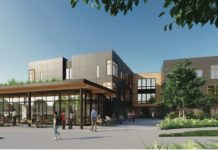


Princeton University is moving forward with a proposal to redevelop two athletic fields next to its football stadium into a state-of-the-art research lab spanning 225,000 square feet situated on a 140-acre site.
After more than two years of deliberation, the municipality’s planning board approved a conditional site plan for a new five-story research facility, known as the Quantum Institute, that will replace Clarke and Strubing fields at the intersection of Fitzrandolph Road and Western Way.
Princeton’s application said that construction is expected to wrap up by 2029, and that the project includes a 15,000-square-foot clean room and a 200-seat auditorium that will expand the university’s growing community in applied sciences and engineering. That facility is the first of three planned expansions to the university’s engineering department.
Professionals working on behalf of the university went back and forth with municipal officials for over a month and a half to iron out the final plans for the research facility. Ultimately, the planning board approved a site plan with conditional variances on October 9.
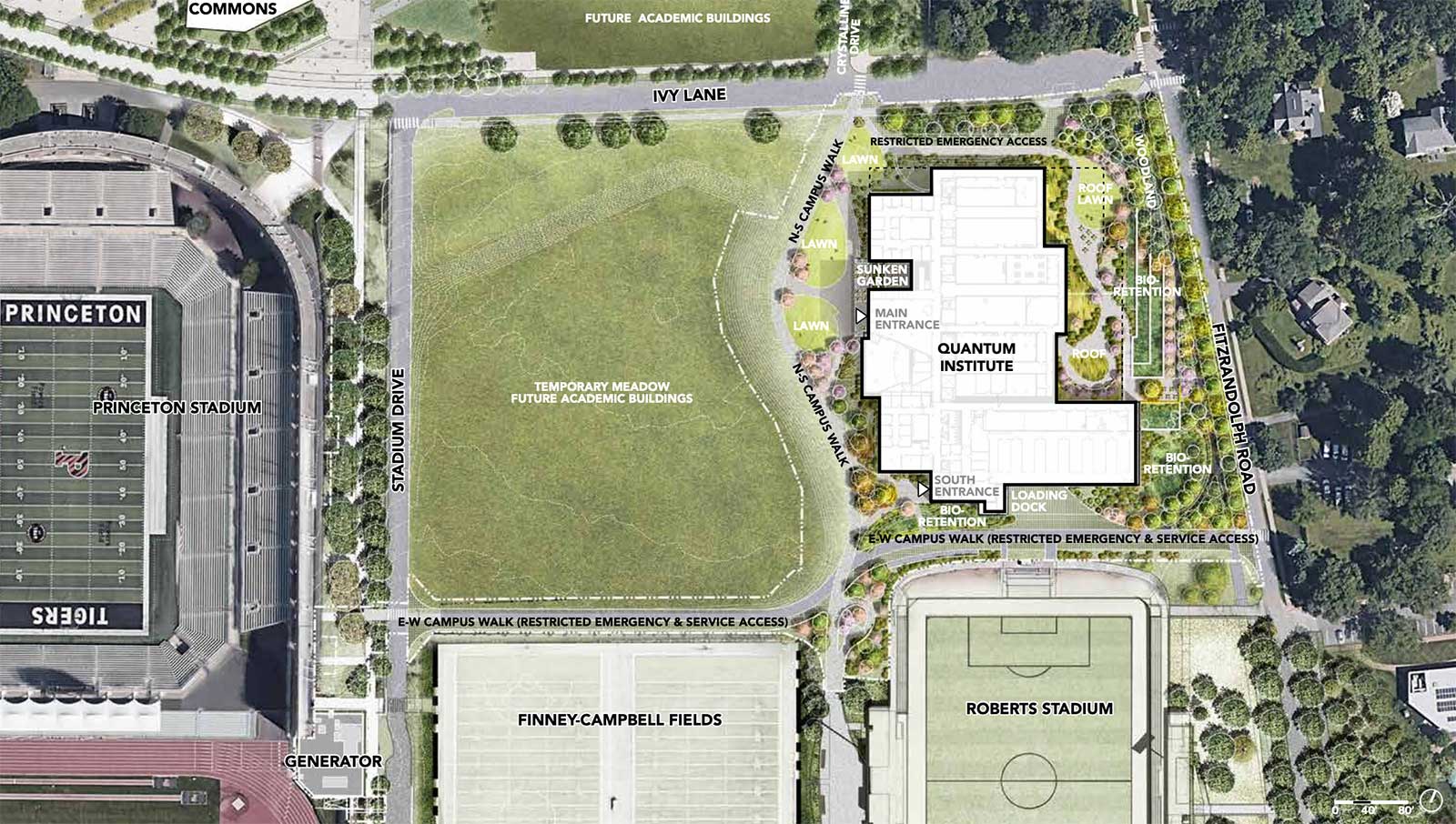
Plans made public by the board and submitted by Boston-based architectural firm Hammel, Green & Abrahamson show that the project spans an entire 141-acre site abutting Roberts Stadium, Finney, and Campbell fields.
Princeton University, which has a massive $36 billion endowment, aims to expand its engineering and applied sciences in the area surrounding its football stadium and southward toward Carnegie Lake. Ultimately, the university intends to connect its main campus with its growing campus in West Windsor, where it owns 900 acres. Jersey Digs reported in December that the university acquired a 21-acre office complex in West Windsor for $33 million.
The area just northeast of the site of the Quantum Institute is slated to become a new four-building facility that will become the new home of the university’s environmental studies and the School of Engineering and Applied Science. That project spans more than 660,000 square feet between Ivy Lane and Prospect Avenue and is expected to wrap up construction this year.
As the university moves forward on its long-term goal to reach carbon neutrality by 2046, it is also investing hundreds of millions of dollars to expand its geothermal exchange system to its entire campus. It is retrofitting more than 180 existing buildings to convert their heating and cooling systems to support the geothermal exchange system.
One feature of the exchange system, known as a bore field, which is a collection of boreholes that contain heat exchange piping, is located on the same site as the Quantum Institute. That part of the project has already been completed, according to a staff report from the planning board.
The university, which was chartered in 1746 as the College of New Jersey, owns approximately 3,500 acres in the eponymous municipality, West Windsor, and Plainsboro. It enrolls approximately 18,300 students and its campus footprint spans over 14 million square feet.
Princeton University did not return a request for comment from Jersey Digs.