

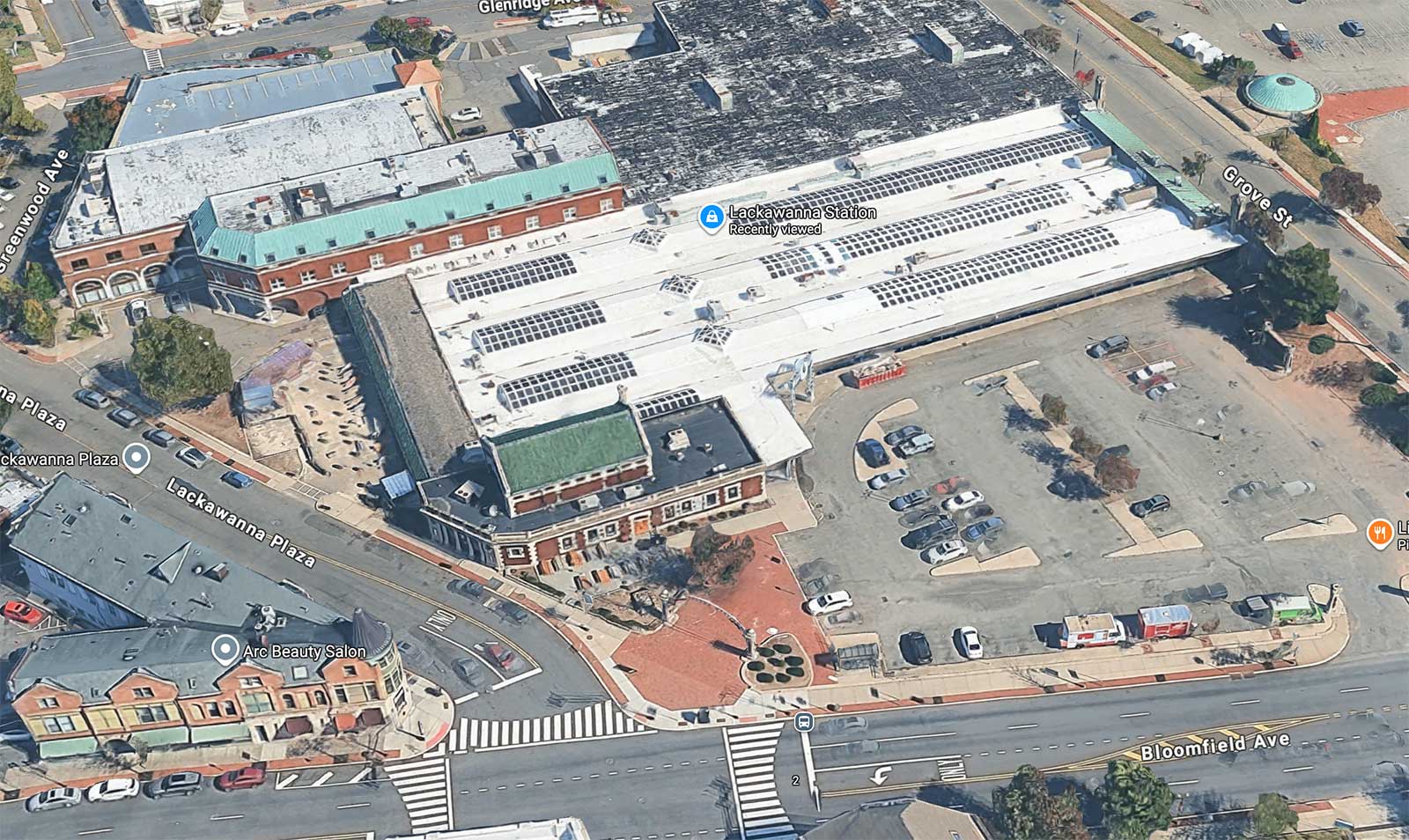
Members of Montclair’s township council are all aboard on the 30-year financial agreement with real estate firm BDP Holdings that will facilitate the construction of new luxury apartments, commercial space, and a grocery store at the defunct Lackawanna terminal downtown.
After tabling a vote on the payment-in-lieu-of-taxes (PILOT) agreement on March 17, members of council voted 6-1 to approve the legislation on March 24, capping hours of deliberation across five council meetings.
Residents, including high school students, went back and forth debating the merits of the project and the financial agreement during the public comment section of the meetings, but the legislation itself is the culmination of decades of negotiations between officials and private developers over the future of the train station, which was first opened in 1930 and ceased operations 45 years ago.
Mayor Renee Baskerville, Deputy Mayor Susan Shin Andersen, and council members Eileen Birmingham, Erik D’Amato, William Harrison, and Rahum Williams all voted in support of the agreement on first reading and adoption, while Council Member Aminah Toler was the only vote against the PILOT. She was the only council member who did not vote to pass the ordinance at first reading due to her absence from the meeting on February 10.
BDP Holdings, according to the PILOT ordinance, wants to build five- to six-story mixed-use buildings that include a 40,000-square-foot supermarket, 75,000 square feet of office space, and 300 apartments. The town’s redevelopment plan says that 60 units will be set aside for affordable housing and that 10%, or 30 units, will be allotted to workforce housing.
The project will be built in two phases. The first phase will require the construction of four buildings, and the second phase will require the construction of a fifth building and two floors of office space above one of the buildings erected in the first phase.
Plans also call for a concealed parking structure and green building technology features, but no site plan application has been filed with the township’s planning board. In fact, the legislation notes that the council agreed, by resolution between January 2025 and December, to extend the time for BDP Holdings to submit a site plan application five times.
Despite a lack of a site plan application, council projects that the redevelopment will create 395 construction jobs over 8 years and 730 permanent jobs from the new supermarket, office, retail, and restaurant components of the project.
For legislators in Montclair, the agreement is, in many ways, a return to the terminus. According to a 1982 New York Times report, a limited liability company called Montclair Center Associates secured federal funds to redevelop the terminal into a shopping complex anchored by a 50,000-square-foot Pathmark supermarket.
At the time, Montclair’s director of planning, Peter Steck, projected the project would create 250 permanent jobs and 135 construction jobs, in addition to generating $125,000 in annual property taxes. That plan, according to a report in Montclair Local, came nine years after a proposal to redevelop the terminal into high-rise apartment buildings was eventually abandoned to preserve the terminal.
The plan from 1982 succeeded in revitalizing the terminus, but things at the shopping center began to unravel when Pathmark closed its doors for good in 2015, and the retail center became underutilized.
The township and real estate developers Hampshire Cos. and Pinnacle Cos. began working on a plan to revitalize the train station two years later, but a series of legal challenges led the joint venture to eventually cede the land to BDP Holdings in 2021, allowing for the current iteration of the plan to move forward.
For residents of Montclair, the main point of contention in approving the financial agreement centered on expediency and benefits to the township, including its school district. Over the course of several council meetings, residents who opposed the financial incentive argued that developers building in Montclair, which has a median home value ranging between $1.10 million and $1.68 million, do not need tax incentives given the municipality’s affluent demographics.
They also pointed to other projects in Montclair that, over the past 15 years, received tax incentives and were sold soon after securing a PILOT, providing no additional benefits to the township from the sale.
Several residents who submitted comments opposing the grant of the financial agreement argued that the Montclair School District should receive a direct benefit explicitly written into the contract with BDP Holdings. A few residents echoed the words of the late Montclair resident and affordable housing advocate Joan Pransky, and read a letter she penned to the council about the Lackawanna Terminal redevelopment in 2025, during the public comments section of the meetings.
On the other hand, residents who submitted public comments in support of the agreement argued that the train station has lain fallow for decades and that the town needed to approve the agreement so the town may benefit from new ratables, a new grocery store, and improvements to the community and the area surrounding the station. Others argued that the creation of new housing will, over time, increase affordability in the township.
While the township council has officially endorsed the project, the next stop is the planning board. BDP Holdings has yet to complete its site plan application. But when it finally arrives, the proposal will clarify the redevelopment’s true specifications, while certainly bringing supporters and detractors together to deliberate on the future of the former terminal.