
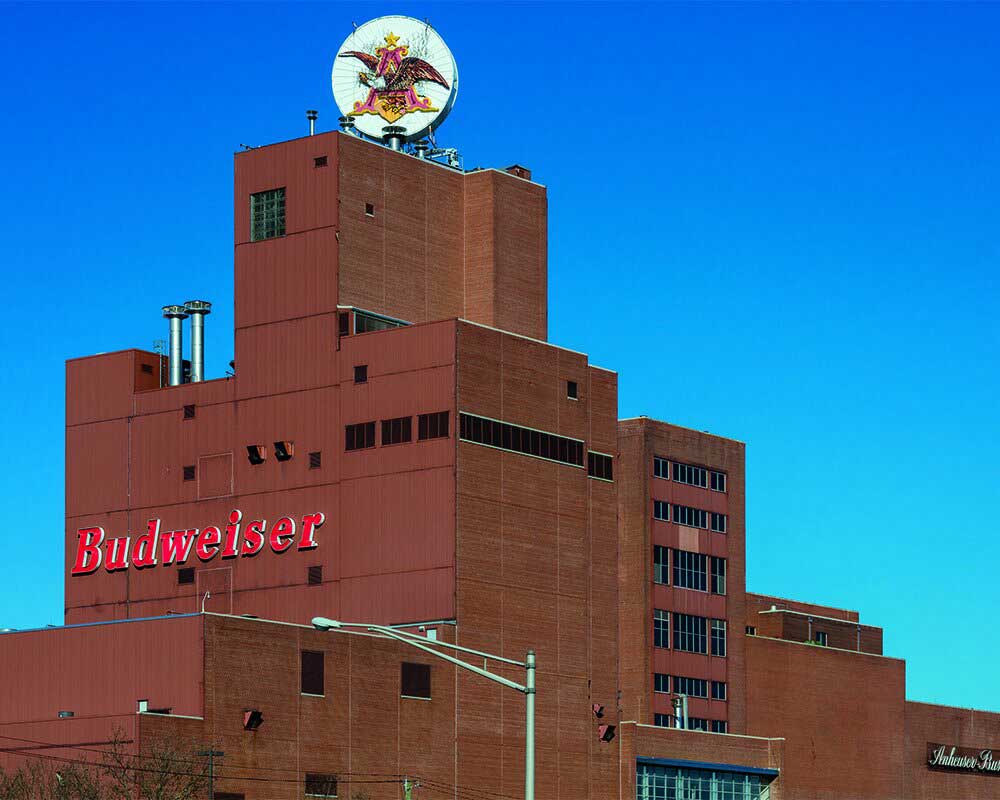
Anheuser-Busch, Newark’s last big brewery, announced this month that it will be closing its brewery near the airport.
The factory’s closure is occurring at a time when the industry is undergoing an upheaval. Beer sales are in decline as the tastes of drinkers seem to be shifting to other forms of alcohol, like seltzers and ciders, while others are abstaining altogether.
But in Newark, the plant’s closure resonated more deeply, as it marks the end of an era—gone is the last remaining stronghold of the city’s once-glorious brewing history. The previous big brewery to close was Pabst in 1986.

The story of beer in Newark is really one about immigration. Many of the great brewers hailed from regions of Germany where beer was part of their cultural heritage, and it was a way for immigrants — which also included primarily Irish, Polish, and Italians — to entertain themselves. There were 122 saloons in the Ironbound alone, and the majority of them were owned by breweries. Willard Price’s history book about the Ironbound, published in 1912, called the neighborhood “beer island” because of the number of watering holes found there.
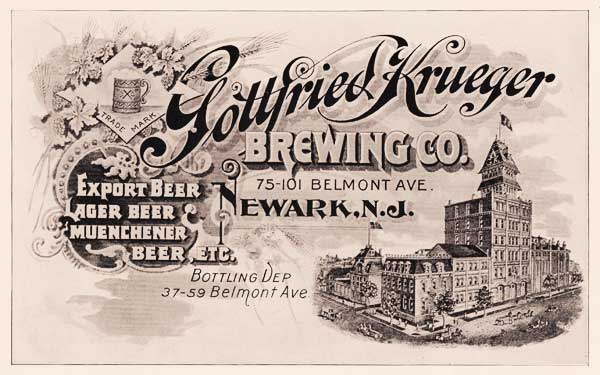
The brewing industry was also a means of upward mobility. Gottfried Krueger famously got his start as an apprentice in his uncle’s company, called Laible & Adam Brewery. Krueger became one of the largest brewers and is credited with being the first to sell canned beer—an innovation that no longer required drinkers to consume the product in bars and restaurants.
There are vestiges of the city’s brewing past, but they are vanishing. There is the Ballantine House, where Peter Ballantine once lived, but his remaining factories in the Ironbound are being demolished for an apartment complex named in his honor. The spectacular mausoleums in the local cemeteries belonging to the likes of Christian Feiganspan, and street names like Schaulk Street, named after John Shaulk, are also woven into the city’s DNA. Krueger’s namesake mansion on MLK Boulevard, which was restored in 2023, is perhaps the city’s most opulent landmark left behind by the brewing industry.
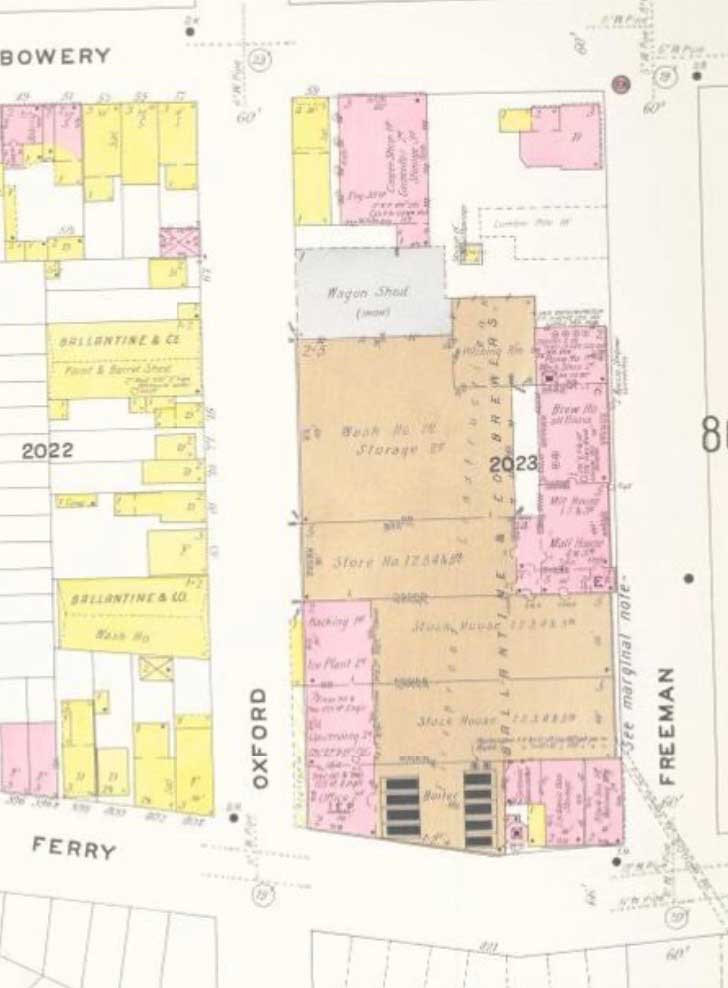
Anheuser-Busch was not native to Newark, but neither was Peter Ballantine, a Scottish immigrant who was last living in Albany before buying a local brewery with a partner. In 1951, when Anheuser-Busch’s new, state-of-the-art brewery opened, it marked a period of consolidation for the city’s many breweries. In Newark alone, there were once more than 50 at its peak.
The company’s Newark brewery was its second plant—the other was in St. Louis—and it was part of the $64 million midcentury investment to ramp up production, with $20 million of that allocated to the new facility in Newark. It created 1,000 new jobs on the day it opened.
Newark’s famous water, piped in from the Pequannock Reservoir, was one of the reasons the company chose to locate here. Another factor was the site’s location, near highways and a freight line. “All of the materials needed to brew beer came in by rail, all of the packaging materials that all came in by rail,” said Milt Rosko, a longtime operations manager. “Then everything that was sent out was basically sent out by rail throughout the northeast, so there was minimal cost.”
Rosko, who died in 2022, was speaking at a Newark Historical Society event in 2009. What was notable about this discussion was that Rosko discussed the potential closure of the brewery. Although beer sales had remained consistent over the years, Rosko said, the rise of microbreweries was causing a shakeup in the industry.
Beginning in the early 2000s, the number of microbrewers swelled from around 100 nationwide to more than 9,000. But behemoth breweries overcame this threat. Some of them tapped into the trending market by creating brands that mimicked craft brewers. For example, Molson Coors created Blue Moon. Other major brewers acquired many of the smaller breweries. In 2020, Anheuser-Busch acquired craft brewers like Kona and Goose Island.
Scott Wells, president of the New Jersey Brewers Guild, said that, nowadays, although the local liquor store may appear to have different brands stocked on their shelves, it is merely an “illusion of choice. They are mostly owned by the same companies, Wells said.
“The biggest players have used muscle to keep the smaller guys off the shelf,” Wells said.
The new threat to the brewing industry is that drinkers are turning more to seltzers, canned cocktails, ciders, and even THC drinks. In 2022, distilled spirits surpassed beer for the first time as the most-consumed alcoholic beverage.
“Since then beer has taken a downturn, so they just dumped these smaller brands,” Wells said.
Wells doesn’t believe that the closing of the Newark brewery means that Anheuser-Busch — with 34 percent of the beer industry’s market share — is in any major financial trouble. “It’s not going to change prices or its availability,” he said. “But it does mean that New Jersey is losing a lot of jobs.”
What Newarkers will perhaps feel most acutely is the loss of a local landmark. Historian Myles Zhang said the brewery’s neon sign featuring an eagle logo was like a gateway to the city. Zhang said these landmarks are as important as statues and monuments.
Other vital neon signs have become iconic to cities, namely the Colgate sign in Jersey City and the Pepsi-Cola sign in Long Island City. When the former Pabst brewery was demolished two years ago. The beer-bottle-shaped water tower was planned for placement along the Passaic River, but it was never built. Despite the news that the Anheuser-Busch sign will be removed and brought to St. Louis, Zhang hopes it instead can be relocated somewhere else on Newark’s riverfront.
“I want our society to erect the sort of monuments that allow us to tell stories about places,” Zhang said.