

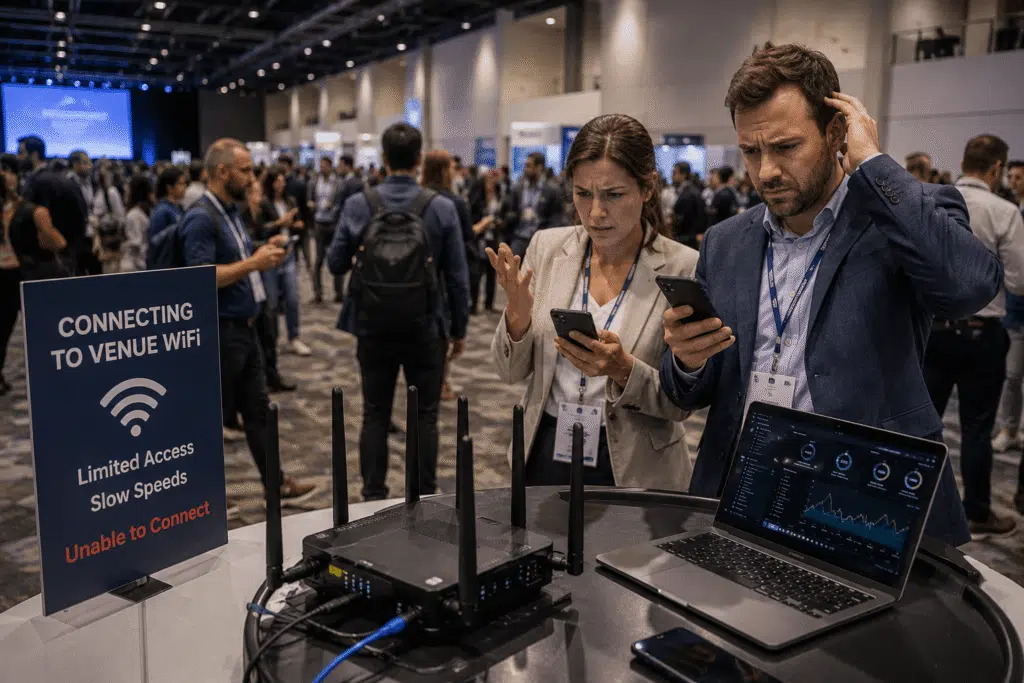
At a rooftop launch party on the Jersey City waterfront this spring, a photographer noticed her upload bar stall around 8:15 PM. Sixty-some guests had spread across the terrace by then, each phone hunting for a signal bouncing off floor-to-ceiling glass and a steel deck two stories below street level. The building’s guest network, built to handle residents streaming from their own units, had nothing left to give a party.
That scene has become familiar as Jersey City’s skyline keeps filling in. Towers from Journal Square to Newport and Harborside were marketed with amenity floors — sky lounges, rooftop terraces, co-working suites — and property managers have leaned into renting those spaces out for private events, corporate mixers, and product launches. The amenities were designed with residents in mind: maybe a dozen people at once, checking email, streaming a show. Nobody sized the network for 150 people with cameras, tablets, and a DJ running a laptop off the same riser.
Concrete and steel, ironically, work against the buildings that need internet the most. Low-emissivity glass — the kind that keeps heating bills down in a 40-story tower — also reflects and scatters cellular signal, which is part of why upper-floor units in some of these buildings report weak reception to begin with. Add a PATH tunnel running underneath parts of Downtown Jersey City, more concrete mass than most suburban venues will ever see, and you get a building that looks great in real estate photos and struggles the moment 80 or 90 devices try to pull a Wi-Fi signal from the same access point at once.
“I’ve had a caterer’s card reader freeze mid-swipe because the sales rep upstairs was on a video call using the same guest network,” said Talia Brennan, an event producer who books rooftop and lobby spaces across the Jersey City waterfront for corporate clients. “Nobody thinks about that until it happens in front of forty people holding drinks.”
Brennan said she now asks building management, before signing any rental agreement, exactly how many devices the guest Wi-Fi is rated to support — and increasingly builds in her own backup internet as a line item rather than an afterthought. “I used to think of it like renting extra chairs,” she said. “Now it’s closer to renting the generator. You don’t want to find out you needed it after the lights are already on.”
Leasing teams don’t publish numbers on this, but property managers who handle amenity-floor bookings across several waterfront towers describe event volume roughly tripling since 2019 — driven mostly by residents renting the space out for their own parties and by outside brands paying for a rooftop with a skyline backdrop for a product shoot. Furniture budgets and event calendars grew with that demand. Network capacity mostly didn’t. One frequently booked tower near Exchange Place still runs its guest Wi-Fi off the same access points installed at construction, rated years ago for a fraction of the device load a Saturday night mixer now brings through the lobby.
That shift has opened space for companies that specialize in dropping a temporary, self-contained network into a building for the length of an event, independent of whatever the landlord already has running. Rather than fighting for bandwidth on a shared circuit, event producers are bringing in bonded-cellular kits that pull from multiple carrier towers at once and stitch the connections together, so a dead spot on one network doesn’t take the whole event down. WiFiT, which has been running event internet rental in Jersey City and other dense East Coast markets since 2015, is one of the more established names event planners in the region turn to when a building’s existing network can’t be trusted to carry a few hundred devices for a few hours.
“We’ve walked into venues where the property’s own IT contact swore the Wi-Fi could handle two hundred people, and by the second hour it’s dropping every call,” said Matt Cicek, CEO of WiFiT. “What actually saves the event is uplink prioritization — deciding in real time which traffic gets through first, because a payment terminal freezing during checkout matters more than someone’s Instagram story buffering. We’ve had techs standing next to a rooftop bar rerouting traffic between three carriers because one tower got overloaded the second three hundred phones showed up at once.”
Cicek said his crew runs a site survey a few days ahead of an event in buildings like the ones going up across Journal Square and the waterfront, checking which carriers actually reach specific floors before committing to a setup — a step he said gets skipped constantly by venues that assume good service downtown means good service on floor 34.
None of this is unique to Jersey City, but the density of new construction here has compressed the timeline. A handful of these towers went from empty lots to fully leased amenity floors within a couple of years, and event bookings followed almost immediately — often faster than property management companies updated their own infrastructure to match. Building engineers, for their part, tend to describe the guest network as adequate for what it was designed to do, which is part of the disconnect: nobody designed it to survive a launch party.
One building engineer at a Newport-area tower, who asked not to be named because he wasn’t authorized to speak for the property, put it more bluntly: the guest network gets rebooted more during event weekends than it does the rest of the month combined, and the fix that actually works isn’t a firmware update — it’s the event company bringing its own pipe and staying off the building’s grid entirely.
There’s a parking-garage version of the same problem, too. Several of these towers route their loading dock and garage-level freight elevator through concrete cores thick enough to kill a phone signal outright, which matters more than it sounds like once caterers and AV crews start hauling gear up from street level and can’t reach anyone on the event floor to confirm a delivery. Brennan said she’s started stationing a runner by the loading dock with a walkie-talkie for exactly that reason — a low-tech patch for a high-rise problem nobody accounted for.
As more of Jersey City’s residential towers double as event space, that separation — the building’s network for residents, a temporary one for everybody else — looks less like an upgrade and more like the baseline anyone booking one of these venues should expect going in.
This article is written in collaboration with WiFiT.net. Want your business featured? Email us, [email protected].
